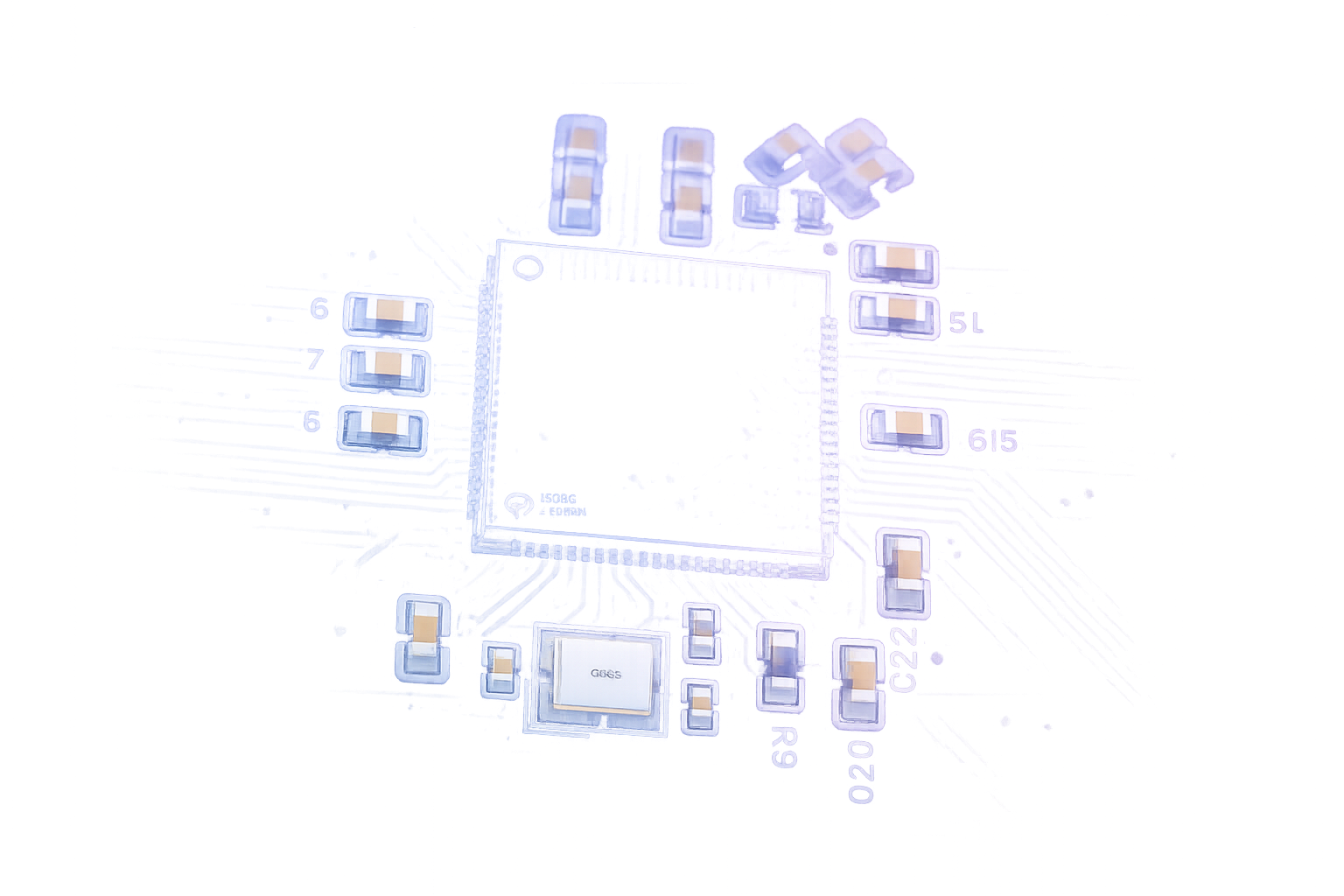
Bioimpedance Analysis (BIA)
Implements tetrapolar bioimpedance spectroscopy using AD5941 electrochemical analyzer IC. Features programmable excitation frequencies from 1 kHz to 250 kHz with 16-bit resolution. Includes MCP6002 operational amplifiers for signal conditioning and MCP4725 DAC for DDS (Direct Digital Synthesis) waveform generation.
- AD5941 Potentiostat: Integrated 16-bit ADC/DAC, programmable gain amplifier, and impedance measurement engine.
- MCP6002 Op-Amp: Low-power rail-to-rail operational amplifier for signal amplification and filtering.
- MCP4725 DAC: 12-bit digital-to-analog converter for precise DDS waveform control.
- Frequency Range: 1 kHz - 250 kHz with programmable sweep for impedance spectroscopy.
- Latest Research: Implements Cole-Cole model fitting for tissue characterization (2023 IEEE TBME papers).
ECG Acquisition System
Three-lead ECG monitoring with right leg drive for common-mode rejection. Uses instrumentation amplifiers and notch filters for 50/60 Hz interference removal. Includes real-time R-peak detection and heart rate variability analysis.
- Lead Configuration: Standard I, II, III with Wilson central terminal reference.
- Bandwidth: 0.05 - 150 Hz with adjustable gain (1x to 1000x).
- Noise Performance: <1 µV RMS input referred noise.
- Right Leg Drive: Active common-mode feedback for motion artifact reduction.
- Latest Research: AI-enhanced arrhythmia detection using wavelet transforms (2024 Nature Medicine).
EMG Signal Processing
Surface EMG acquisition with high common-mode rejection ratio. Features adaptive filtering and muscle fatigue analysis using mean frequency shift detection.
- Electrode Interface: Differential amplification with >100 dB CMRR.
- Frequency Response: 10 - 500 Hz bandpass with 60 Hz notch filter.
- Dynamic Range: 60 dB with automatic gain control.
- Analysis Features: RMS amplitude, mean frequency, median frequency tracking.
- Latest Research: Machine learning classification for gesture recognition (2024 IEEE TNSRE).
Python GUI Controller
Real-time control interface built with PyQt5 and matplotlib. Features frequency sweep control, live signal visualization, and automated measurement protocols.
- Frequency Control: Programmable excitation from 0.1 Hz to 1 MHz.
- Real-time Plotting: Live ECG/EMG waveforms and impedance spectra.
- Data Export: CSV/EDF format with metadata and calibration info.
- Protocol Automation: Pre-configured measurement sequences for research studies.
- Latest Research: Integration with OpenBCI framework for standardized biosignal processing (2024).